Our Products#
Lab509 delivers software and simulation products that help researchers and engineers model, simulate, and analyze nanoscale systems. Below are a few representative offerings — contact us for custom solutions.
Virtual-QCM#
Accelerating QCM research through first-principles modeling
Virtual-QCM is a disruptive digital platform that accurately reproduces quartz crystal microbalance (QCM) signals, accelerating research and reducing experimental costs across applications such as biosensing, polymers, corrosion, toxin detection, and drug design.
The science behind Virual-QCM
The platform is grounded in a dedicated research line focused on the fundamental physics of QCM signal generation and interpretation. Its predictive capabilities are supported by peer-reviewed studies that establish a rigorous theoretical and computational framework.
-
Pablo Palacios-Alonso, Raúl P. Peláez, & Rafael Delgado-Buscalioni. Fast spectral solver for viscoelastic structures under oscillatory flow in free space or wall-bounded domains: Applications to quartz crystal microbalance and force spectroscopy, J. Chem. Phys. 163, 194109 (2025) ↗.
-
Raúl P. Peláez, Pablo Palacios-Alonso, & Rafael Delgado-Buscalioni. Spectral solver for the oscillatory Stokes frequency-based equation in doubly periodic confined domains, J. Fluid Mechanics, 1010 (2025) ↗.
-
Rafael Delgado-Buscalioni. Coverage Effects in Quartz Crystal Microbalance Measurements with Suspended and Adsorbed Nanoparticles, Langmuir, 40, 1, 580–593 (2024) ↗.
-
Marc Meléndez Schofield & Rafael Delgado-Buscalioni. Quantitative description of the response of finite size adsorbates on a quartz crystal microbalance in liquids using analytical hydrodynamics, Soft Matter, 17, 8160-8174 (2021) ↗.
-
Adolfo Vázquez-Quesada, et al.. Hydrodynamics of Quartz-Crystal-Microbalance DNA Sensors Based on Liposome Amplifiers, Phys. Rev. Applied 13, 064059 (2020) ↗.
-
Marc Meléndez Schofield, Adolfo Vázquez-Quesada & Rafael Delgado-Buscalioni. Load Impedance of Immersed Layers on the Quartz Crystal Microbalance: A Comparison with Colloidal Suspensions of Spheres, Langmuir, 36, 31, 9225–9234 (2020) ↗.
ACMHyst#
Decoding AC magnetic hysteresis with predictive digital twins
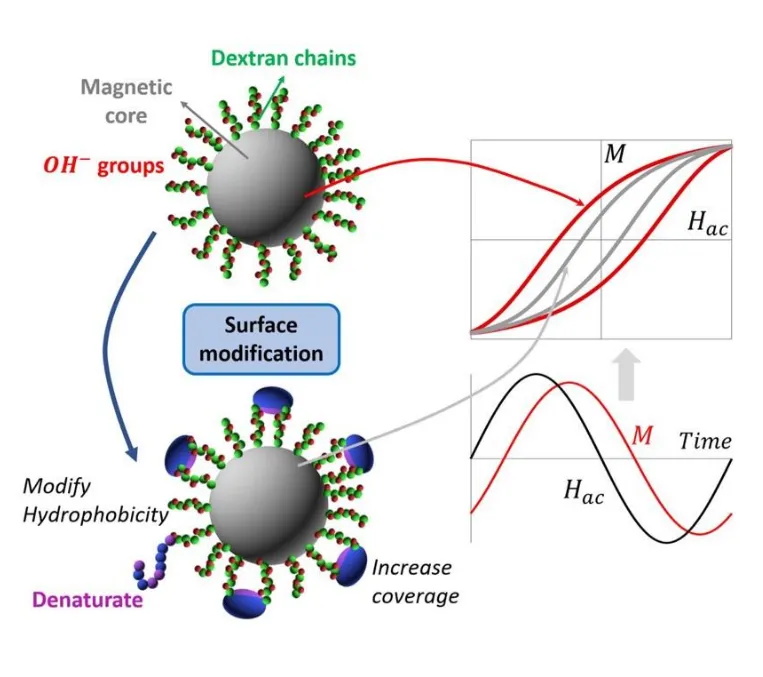
ACMHyst is our digital twin of AC magnetic hysteresis signals from magnetic nanoparticles. It a predictive computational tool for interpreting AC magnetic hysteresis signals from functionalized magnetic nanoparticles, enabling precise, simultaneous characterization of nanoparticle properties and key solvent parameters, including viscosity and temperature. Try now!
From signal to physical insight
ACMHyst is built upon a research program that combines first-principles modeling of magnetic dynamics with advanced signal analysis. Its methodology has been validated against published results, providing a robust scientific basis for parameter inference from AC hysteresis measurements.
-
Pablo Palacios-Alonso, et al.. Fast and accurate characterization of bioconjugated particles and solvent properties by a general nonlinear analytical relationship for the AC magnetic hysteresis area, Nanoscale,17, 12963-12980 (2025). ↗.
-
Elena Sanz-de Diego, et al.. Multiparametric modulation of magnetic transduction for biomolecular sensing in liquids, Nanoscale, 16, 4082-4094 (2024) ↗.
Virtual-AFM#
Turning vibrational spectra into mechanical response
Virtual-AFM is a predictive computational tool designed to interpret atomic force microscopy (AFM) vibrational spectra of biomolecules, cells, and soft matter systems. It bridges experimental AFM measurements with underlying mechanical and dynamical properties across biological and soft-matter scales.
Research-driven interpretation of AFM measurements
This platform stems from a line of research dedicated to the first-principles description of AFM–sample interactions and vibrational dynamics. Its predictive framework is supported by peer-reviewed publications that establish a direct connection between measured spectra and material properties.
-
A. Díez-Martínez, et al.. The tubular cavity of tobacco mosaic virus shields mechanical stress and regulates disassembly, Acta Biomaterialia 198, 356–365 (2025) ↗.
-
Klara Strobl, et al.. Electromechanical Photophysics of GFP Packed Inside Viral Protein Cages Probed by Force-Fluorescence Hybrid Single-Molecule Microscopy, Small, 18, 2200059 (2022) ↗.
-
Natalia Martínez-González, et al.. Long-Range Cooperative Disassembly and Aging During Adenovirus Uncoating, Phys. Rev. X 11, 021025 (2021) ↗.